
9.21.2026- DOJ Federal Firearm Rights Restoration: The Right Was Never Gone... The Process Was

For more than 30 years, federal law technically provided a way for certain Americans prohibited from possessing firearms to ask for their federal firearm rights back.
There was just one rather significant problem.
For most individuals, the process was effectively unavailable.
Well, that begins changing today!
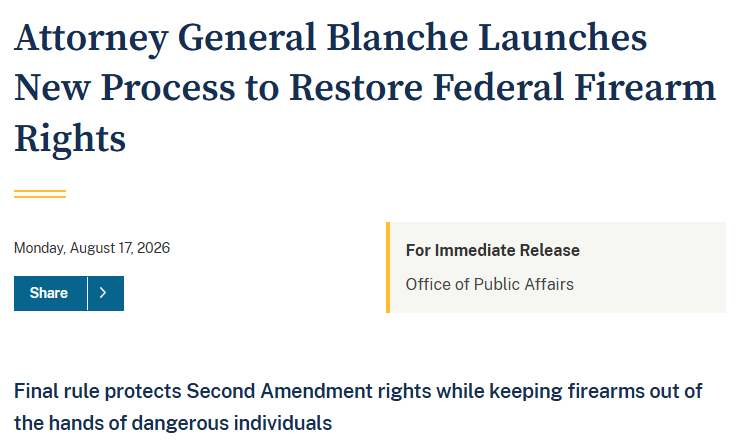
On September 21, 2026, the Department of Justice's final rule establishing a new Federal Firearm Rights Restoration process under 18 U.S.C. § 925(c) officially takes effect. The rule creates an administrative process for people prohibited under federal law from possessing or otherwise handling firearms to seek individualized relief from that federal disability.
After more than three decades of a process that existed largely on paper, that's a significant Second Amendment development.
Congress Created the Process.
Then Congress Defunded It.
Section 925(c) isn't new.
Federal law already allows the Attorney General to grant relief from certain federal firearm disabilities when an applicant can demonstrate that the circumstances surrounding the disability, along with the person's record and reputation, establish that the person is unlikely to act dangerously and that granting relief would not be contrary to the public interest.
Beginning in 1992, however, Congress prohibited ATF from using appropriated funds to investigate or act upon individual § 925(c) applications.
The law remained on the books. For most individuals, the practical mechanism for using it did not.
DOJ's NEW rule changes that by moving responsibility for individual applications from ATF to the Department of Justice, where the Office of the Pardon Attorney will administer the process.
The Rule Starts Today.
Applications Don't, At Least Not for Everyone.
This part is important.
The final rule officially becomes effective September 21, but DOJ is rolling out the application system in stages.
Invited applicants are scheduled to begin applying September 25. On November 4, DOJ plans to open the process to the first 5,000 members of the public on a first-come, first-served basis.
On January 4, 2027, DOJ plans to admit another 500 applicants while testing its online payment system. DOJ says collection of the $30 application fee will begin with that January phase. Once the Department is satisfied that its processes are working, it says it will open access to the public at large.
So, the rule officially takes effect today.
Most people just can't use it yet.
Government gonna government. Nah mean?
Who Can Apply?
DOJ says individuals currently prohibited from possessing or otherwise handling firearms under any category of 18 U.S.C. § 922(g) are eligible to apply.
That includes prohibitions involving felony convictions, fugitive status, unlawful drug use, certain mental-health adjudications or commitments, certain immigration statuses, dishonorable military discharge, renunciation of U.S. citizenship, qualifying domestic-violence restraining orders and misdemeanor domestic-violence convictions.
Eligible to apply does not mean eligible to receive relief.
DOJ has created several categories of presumptive disqualifiers based on an applicant's convictions or current status. Depending on the circumstances, some presumptions last five or ten years after completion of a sentence, while others are permanent. Applicants subject to one of these presumptions generally must demonstrate “extraordinary circumstances” sufficient to overcome it.
This is individualized review, not automatic restoration.
Asking for Your Rights Back Comes With Homework
Applicants will have to provide substantially more than a name and case number.
The process requires background-release authorization, criminal-history documentation, electronic fingerprints and three character references.
Applicants must provide state criminal-history records covering every place they have lived during the previous 25 years, or since turning 18 if that period is shorter. Those records must show arrests or a clear record, along with records of other arrests during the applicable period.
Additional documentation depends on the reason for the federal prohibition and can include charging documents, judgments, sentencing records, military records and other government records.
For someone prohibited under § 922(g)(4) because of a qualifying mental-health commitment or adjudication, DOJ requires records concerning the original commitment or adjudication, medical records identifying the diagnosis that caused it and a current certification from a licensed mental-health professional stating either that the person no longer suffers from the condition or that it has been successfully treated or stably managed such that the person is unlikely to be a danger to themselves or others.
Fingerprints are also very specific.
Applicants cannot simply go anywhere that offers fingerprinting. DOJ requires fingerprints through the USPS electronic fingerprinting process. After beginning the electronic application and receiving the necessary information from the government, the applicant must use a participating Post Office. DOJ says fingerprints obtained through another process will not be accepted.
And none of this is necessarily free.
The application fee is $30 once DOJ begins collecting it, although applicants can request a waiver or reduction, including because of indigency. Fingerprints, criminal records and obtaining other required documents may carry additional costs.
For its economic analysis of the program, DOJ used an estimate of 330,000 individual applications in calculating the potential costs associated with the rule.
Getting Federal Rights Restored Doesn't Override State Law
This distinction matters.
A successful § 925(c) application restores the applicable federal firearm rights covered by the relief.
It does not erase the underlying conviction, and it does not automatically remove an independent state or tribal firearm prohibition.
Following a grant, DOJ says the FBI will update NICS, and the recipient may also receive a special identifying number, known as an RPIN, that can be used during future firearm purchases.
There is another detail applicants should know: federal law requires DOJ to publish the name of a person receiving relief in the Federal Register. DOJ says it will also publish the date of the grant. Denials are not published.
If DOJ denies an application, § 925(c) allows the applicant to seek judicial review in the U.S. district court where they live.
That may prove particularly important. For decades, the administrative process was effectively unavailable to most individuals. Making it operational again also creates a practical route to judicial review following an actual denial.
Restoring a Right Versus Justifying Its Loss
The new process gives people something they haven't meaningfully had for decades: an individualized pathway to recover federal firearm rights.
That's significant.
But it doesn't settle the larger constitutional question currently being fought in federal courts.
An administrative restoration process asks whether the government should grant an individual relief from an existing firearm prohibition.
Second Amendment challenges to laws such as § 922(g)(1) ask a different question: whether the government has constitutional authority to continue disarming that particular person in the first place.
Those are not the same question.
Starting today, DOJ has officially revived a federal pathway that had been functionally closed to most individuals since 1992. The rollout will be slow, the application requirements are substantial, and most applicants still cannot submit anything today.
But the process is back.
And now we get to see how the federal government actually decides who gets their Second Amendment rights restored.
*Additional Resource: DOJ Final Rule for Federal Firearm Rights Restoration


Comments