
The Gun Control Movement Understood the Power of Culture Before Much of the Second Amendment World Did

Organizations like Everytown for Gun Safety and Moms Demand Action did not become culturally influential by accident, and I think that is something much of the Second Amendment world still struggles to fully understand. Too many people still approach modern activism like it is 1995. Write an angry post. Make a meme. Wait until after legislation moves. Show up to a rally. Repeat the same slogans louder than the other side and hope public opinion magically shifts. Then they look around confused wondering why the opposition seems to dominate cultural conversations, community influence, and emotional messaging.

The reality is that modern influence operations are far more sophisticated than many people realize. You are not arguing against random moms on Facebook armed with Canva graphics and hashtags. You are arguing against professionally built systems created by elite branding agencies, behavioral messaging strategists, digital mobilization firms, UX designers, political media consultants, and narrative architects who understand exactly how culture is shaped over time. That is not praise. That is simply recognizing the battlefield for what it actually is.
The Branding Side of Modern Activism
Groups like Everytown invested heavily into understanding branding, psychology, emotional framing, and long-term cultural integration. Firms like Wieden+Kennedy helped produce emotionally provocative campaigns designed to shape perception and identity, not merely argue policy. That matters because emotional identity is often far more powerful than facts alone when it comes to influencing public behavior. Much of the gun rights world still communicates like a policy organization while their opposition communicates like a modern consumer brand. One side is trying to win arguments. The other side is trying to shape culture.
This is one of the biggest disconnects I continue seeing in the Second Amendment world. Many organizations still rely heavily on reactive messaging, outrage cycles, and repetitive slogans while the opposition focuses on emotional consistency, polished branding, and long-term narrative reinforcement. Whether people like hearing it or not, branding matters because perception matters.
Bellweather and the “Be SMART” Strategy
Then you look at campaigns like “Be SMART,” developed with the help of Bellweather Agency, and the strategy becomes even more obvious.
Notice the language being used. Not confiscation. Not bans. Not punishment. The messaging is centered around safety, responsibility, children, parenting, and community trust. It is intentionally framed in a way that feels socially familiar and morally safe to everyday people who may not know much about firearms. That is strategic communications. It is designed to integrate naturally into schools, pediatric conversations, neighborhood groups, and parent culture instead of looking overtly political or aggressive.
This is something many gun owners still underestimate. Cultural influence spreads far more effectively when ideas are wrapped in emotional familiarity and social trust rather than overt political confrontation. The anti-gun movement understood that years ago.
Purpose and the Engineering of Modern Movements
Firms like Purpose specialize in movement-building and social mobilization strategy. That means they understand how to create participation systems where activism itself becomes part of a person’s identity. They understand emotional reinforcement, community integration, narrative consistency, and digital engagement ecosystems.
In plain English, they understand how to make people feel emotionally connected to a movement long-term instead of just temporarily angry about a single event.
Meanwhile, much of the Second Amendment world still revolves around reactive outrage cycles that burn hot for a few days before disappearing into the next controversy. That is not sustainable culture-building. That is reaction management.
MVAR Media and Targeted Political Persuasion
Then there are firms like MVAR Media, which specialize in targeted political media campaigns and demographic-based persuasion strategies.
Different audiences receive different messaging because different emotional appeals resonate with different groups. Parents hear one narrative. Younger voters hear another. Urban communities hear something different than rural communities. The messaging is adaptive, psychological, and data-driven.
Again, none of this happens accidentally.
Modern political communication is no longer simply about arguing facts. It is about understanding audience behavior, emotional triggers, perception patterns, and social identity dynamics.
Upstatement and Digital Infrastructure
Finally, firms like Upstatement helped build the digital infrastructure behind branding systems, engagement platforms, and content ecosystems.
Most people underestimate how important that part is.
Websites are no longer just websites. They are onboarding systems, retention systems, participation funnels, data collection systems, and behavioral engagement tools designed to keep people emotionally connected to a cause long-term. Everything from layout and color schemes to email capture systems and content flow is built intentionally to maximize participation and retention.
That is infrastructure. And infrastructure sustains movements.
What the Second Amendment Community Needs to Learn From This
Before anyone twists this article into me “praising” the anti-gun movement, let me make something very clear:
Recognizing effective strategy is not the same as agreeing with the mission behind it.
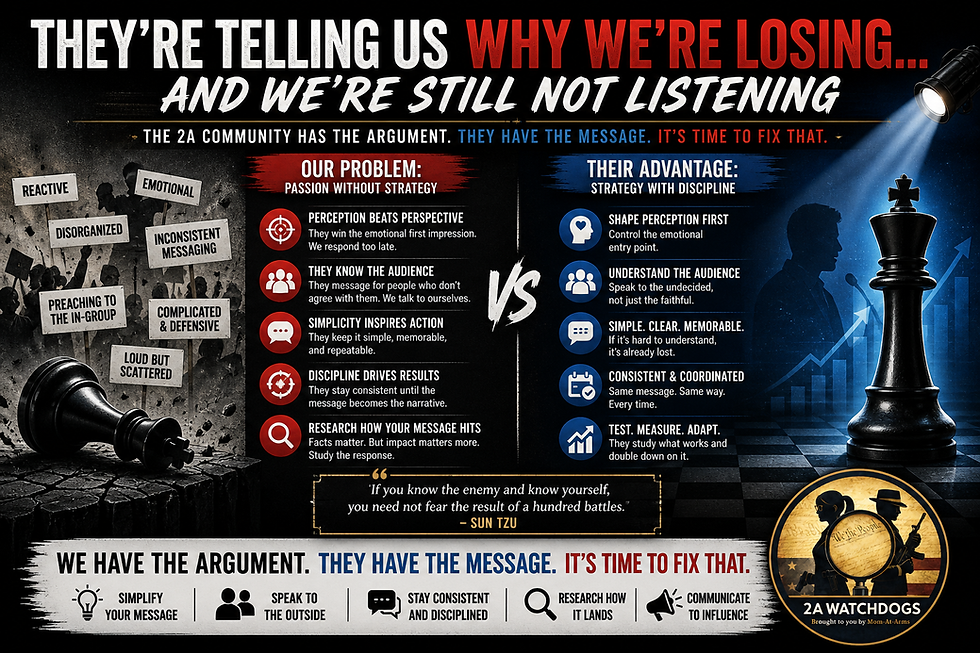
The reality is that the gun control movement invested heavily into understanding communications, branding, behavioral psychology, timing, and cultural infrastructure while much of the Second Amendment world remained reactive, fragmented, personality-driven, and inconsistent in its messaging.
One side built systems. The other side often built reactions.
And no, the 2A community does not have Bloomberg-level billionaire money backing most of its efforts. That absolutely matters. The anti-gun movement has access to massive financial infrastructure, media relationships, professional agencies, and institutional partnerships that many grassroots gun rights organizations simply do not have.
But that does not excuse poor strategy.
We may not have billions of dollars, but we can absolutely become more disciplined, organized, and intentional in how we communicate.
Far too often, Second Amendment messaging becomes an echo chamber directed only at people who already agree with us. We recycle the same phrases, the same outrage posts, and the same talking points without asking whether any of it is effectively reaching the people in the middle who are emotionally uncertain, politically disengaged, or simply uninformed.
Meanwhile, the opposition constantly tailors messaging toward audiences outside of their base.
That matters.
If the goal is preserving rights long-term, then communication cannot revolve solely around energizing the angriest people already inside the movement. Messaging also has to: educate, build trust, reduce fear, create familiarity, and reach people who are politically undecided or culturally disconnected from firearm ownership.
That requires emotional discipline and strategic timing.
And timing is another area where the anti-gun movement consistently outperforms much of the Second Amendment world.
They understand legislative timing.
They understand media timing.
They understand emotional timing.
Notice how quickly coordinated narratives appear after major national events. Notice how rapidly messaging campaigns activate before legislative sessions, during committee seasons, during election cycles, and during key cultural moments. Their communication systems are rarely random. Messaging cadence is often synchronized with opportunities to influence perception, pressure lawmakers, shape media narratives, or emotionally activate supporters.
Meanwhile, much of the 2A community waits until after bills are already moving, after committee votes are already happening, or after public narratives have already solidified before reacting emotionally online.
That is backwards.
By the time most people are posting angry memes, the groundwork has often already been laid months earlier through coordinated messaging, community outreach, media framing, lobbying efforts, donor mobilization, and cultural reinforcement.
As someone with a background in communications and organizational psychology (COUNTER PROPAGANDIST), this is exactly why I continue pushing civic literacy, long-term engagement, community outreach, women’s involvement, youth education, local partnerships, and consistent public-facing communication strategies. Rights are not preserved through outrage alone. They are preserved through culture, relationships, education, timing, and sustained public trust.
The anti-gun movement understood long ago that culture shifts before legislation does.
The Second Amendment community needs to fully understand that, too.



Comments