
They’re Telling Us Why We’re Losing... And We’re Still Not Listening

A friend of mine in the Second Amendment Community made a comment recently that stuck with me. They said there’s no time like the present for people to wake up and get involved, and that when she sees energy, especially around rallies, she’s going to fan that flame regardless of timing.
On the surface, that sounds right. It sounds encouraging. It sounds like action.
And to be clear, because LAWD HAMMERCY, I've been catching some flack on some of my stances on the matter, the intent behind it is not wrong.
BUT... the strategy behind it is where things start to fall apart.
Not to pick on her specifically, especially if she reads this, but she's not the only one. That mindset reflects something much bigger than her one comment. It reflects how a large portion of the 2A Community still thinks about engagement, visibility, and what it means to be effective. There is an assumption that energy equals impact, that showing up at random equals influence, and that any momentum is good momentum no matter when it happens.
The problem is, that’s not how influence actually works.
In a state like Virginia, where most legislative decisions are made early, often in committee, and on tight timelines that most people never track, timing is not just important.
It determines outcomes.
Energy applied at the wrong time does not change decisions. It reacts to them.
That distinction matters, because rallies can be effective when they are used strategically. The Virginia Citizens Defense League (VCDL) has demonstrated this for years. Their presence during Virginia’s legislative session, particularly at key moments when legislation is still being shaped, has played a major role in pushing back on harmful bills.
That is not accidental.
It is pressure applied at the right time, in the right place, when it can still influence the outcome. Granted, VCDL has not won every fight, but they have been effective in redirecting, reshaping, and even stopping many gun control bills as they move through Virginia’s General Assembly during legislative sessions. To some, those wins may seem small or repetitive. From a strategic standpoint, they are anything but. They are necessary building blocks that create the foundation for larger, long-term impact. And yes! VCDL has rallies! They were even the host of the most historic one in 2A History back in 2020, but... it, like every single one they have every year, is intentionally timed with their lobbying.

That is very different from treating rallies as a default response to momentum or frustration.
Groups like Moms Demand Action, Everytown for Gun Safety, and March for Our Lives built much of their early visibility through rallies and social media amplification. We can even go back to the Brady days of big marches and outrage protests. That phase helped them gain recognition, mobilize supporters, and establish a presence.
If you pay attention now, though, that is no longer where their strategy is centered.
They have not disappeared.
They have evolved.
They were very smart in taking advantage of new age tech and "influence" back when it was fresh and people were running to it for entertainment and information. It helped them with their massive rallies and marches, but even they know when a trend loses its flare. Fast forward to the present day, their focus has shifted toward shaping perception, refining messaging, and influencing how issues are understood long before they reach the point of public reaction.
When they do mobilize publicly, it is done with intention for networking or community outreach, not as a default response. A quick Google search will show you that they choose a more "boots on the ground" approach.
That is the progression the 2A community has not fully made.
The question isn’t whether people are willing to show up.
The question is whether we’re showing up where it actually changes outcomes.
They’re Telling Us Exactly Why We’re Losing annnnnd We’re Ignoring It
There’s something happening right now that most people in the 2A space are completely missing. The opposition is telling us out loud exactly where we’re weak, yet instead of listening, we tend to brush it off simply because we do not like who the message is coming from. That instinct is understandable, but it is also a mistake.

I have been watching Max Steele’s posts for quite some time, now. This is not based on one or two screenshots that happened to cross my feed, but on consistent observation, paying attention to how he frames issues, what he emphasizes, and how he talks about messaging itself. Steele serves as a Senior Communications Director for Everytown for Gun Safety, which means his role is not centered on policy or legal analysis, but on communications. His work focuses on message development, narrative framing, and shaping public perception, and that distinction matters more than most people realize.
When someone whose job is to influence how people understand an issue begins pointing out weaknesses in how your side communicates, it is worth paying attention. I do not agree with his politics or his end goal, but that is not the point. The point is that he is identifying a problem, and that problem is real. He is not talking about passion, turnout, or who is more committed to the Second Amendment. He is talking about communications, and that is where the gap exists, because if you’re not studying how they shape the conversation, you’re always going to be reacting to it.
We’re Loud. They’re Structured.
The 2A community is not lacking voices. In fact, the opposite is true. There is no shortage of people willing to speak, post, react, and engage with every headline, every news cycle, and every viral moment. On the surface, that level of activity can feel productive, as if constant engagement naturally leads to influence.
However, activity without coordination does not create impact.
What we are seeing instead is a lack of consistent direction, a lack of shared messaging, and a lack of discipline in how information is delivered. The result is a flood of opinions that, while often valid on their own, do not reinforce each other in a meaningful way. When multiple people are discussing the same issue but framing it in entirely different ways, the message becomes fragmented. That fragmentation creates confusion, and confusion prevents movement.
On the other side, communications operates within a structured framework. Professionals like Steele do not simply react; they work within systems where messaging is developed, refined, and deployed with intention. There is alignment in what is said, when it is said, and how it contributes to a broader narrative. Because of that alignment, their messaging remains consistent even when it is delivered by multiple voices, and that consistency is what builds recognition and, ultimately, influence.
If you’re not studying how THEY shape the conversation, you’re always going to be reacting to it. That said, professionals like Max Steele, although they're working to shape messaging, they'e also collecting data from the conversations WE are having. So, keep that in mind 2A Community.
“Comms” Is Not Posting on Social Media
One of the most significant misunderstandings within the 2A community is the belief that posting is the same thing as communicating. While posting can be part of communication, it is not communication in and of itself.
Venting frustrations, reacting to headlines, or simply raising awareness without a defined objective does not constitute effective communication. Real communication requires intention. It begins with a clear goal, identifies a specific audience, and is designed to produce a particular outcome.
Communications professionals operate with that level of precision. They do not create messages simply to be heard. They create them to shape how an issue is understood. That distinction is critical, because it determines whether a message has impact or simply adds to the noise.
At present, much of the 2A space measures success by activity metrics such as engagement, shares, or visibility. While those metrics can indicate reach, they do not necessarily indicate effectiveness. A message is only effective if it moves someone, whether that movement is from unawareness to awareness, uncertainty to clarity, or passivity to action. Without that movement, communication has not achieved its purpose.
They Understand the Audience. We Assume It.
Another key difference comes down to who the message is actually built for. The opposition does not build messaging for themselves. They build it for people who are not already on their side, especially people who do not follow policy, do not understand firearms, and are reacting emotionally to what they see.
That is why their messaging is simple. It is not because they lack information, but because they understand how people process it.
A clear example of this can be seen in one of their ads from years ago. It showed two children standing side by side. One child was holding a toy, and the other was holding a rifle. The message was simple: one of these is banned in schools, and the other is not.
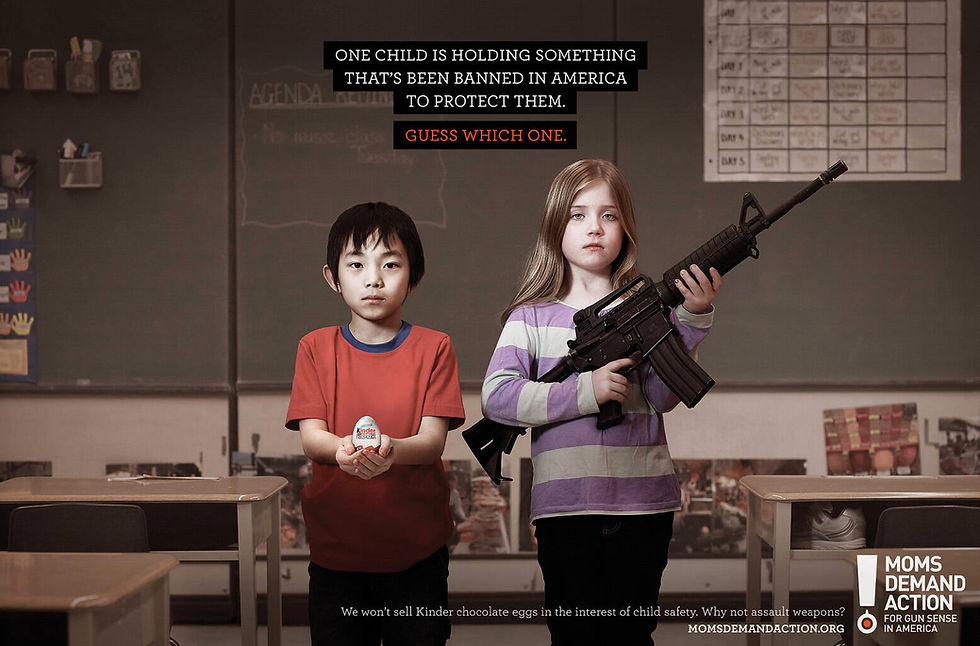
The claim itself was not entirely accurate when you look at actual laws and context, but that was not the point.
The point was that it was easy to understand, easy to remember, and easy to feel something about. It did not require explanation. It created an immediate reaction.
That is what effective messaging does.
Now compare that to how the 2A community often presents itself.
Much of the messaging leans heavily on tactical imagery, military-style visuals, or law enforcement themes. The tone is often intense, defensive, or directed at people who already understand the issue. While that may resonate within the existing base, it does not translate well to the broader public.
The reality is that the vast majority of gun owners are not military. They are not law enforcement. They do not get to the range everday. They do not buy a ton of tactical gear to have on hand when the grid goes down. They are not pro-shooters looking for an endorsement deal.
They are everyday people. With DIFFERING ideologies and values.
When the 2A messaging is built around a narrow identity... like being all "tacticool"... it limits who it connects with.
Instead of expanding understanding, 2A messaging reinforces an in-group... or, in simpler terms... an echo chamber. And when messaging only speaks to the in-group, it does not move anyone new.
If someone has to work to understand your message, or if they cannot see themselves in it, they are going to tune it out. They will get bored. That is not a failure of the audience. It is a failure of the message.
Gun Control orgs and their messaging make people feel something first.
The 2A community often tries to make people understand something first. In today’s environment, that difference matters.
Perception vs. Perspective: Where This Is Actually Won
Perception and perspective are not the same thing, and if you are paying attention, you can see both at play in how issues are shaped, sold, and defended in the public space.
Perception is immediate. It is emotional. It is what people feel when they see something, hear a story, or are presented with a moment that pulls at them. It does not require deep understanding. It requires a reaction.
That is why it is so powerful.
The opposition understands this.
It's Marketing 101.
They build messaging that reaches people quickly, before deeper questions are even asked. They know that if they can control perception first, they can control the direction of the conversation. They do not need to win on depth if they win on emotion early. They do not need to explain everything if they can make someone feel something strongly enough in the moment.
That is not accidental.
It is intentional.
Perspective operates differently. It is slower and requires context. It looks at patterns, timing, intent, and the bigger picture beyond a single moment. It is where real understanding lives, and it is where long-term strategy is built.
That is where the 2A community is supposed to operate.
However, this is where the breakdown happens.
Too often, the 2A side starts from a place of perspective (facts), but the moment pressure is applied, it falls back into perception (feelings). Instead of staying anchored in a clear, structured message, it reacts to whatever is being pushed in the moment. Instead of reinforcing patterns, it chases headlines. Instead of maintaining clarity, it gets pulled into emotional back-and-forth exchanges that muddy the message it is trying to defend.
You can see this most clearly in how certain talking points are used.
When messaging does not land, the response is often to repeat the same phrases louder, as if repetition alone will create understanding. One of the most common examples is “shall not be infringed.” It is a direct quote from the Second Amendment, and within the 2A community, it is seen as clear and absolute.
But clarity within a community is not the same as clarity to an outside audience.
To someone who is already aligned, that phrase reinforces belief. To someone on the fence, it often triggers a different response entirely.
Why?
That is where the opposition has learned to operate.
Instead of engaging the phrase at face value, they redirect it. They turn it into a question. They shift the conversation away from the statement itself and toward its meaning. They move the audience from hearing a declaration to asking for an explanation.
And once that shift happens, the advantage changes.
Because now the burden is no longer on them to persuade. It is on the 2A side to explain, justify, and defend in real time, often without a clear, simplified message prepared for that moment. That is where things begin to break down.
The issue is not the phrase itself. The issue is what comes after it.
If “shall not be infringed” leads to a scattered, inconsistent explanation, the message loses its strength. But if it leads to a clear, consistent, and repeatable explanation that connects with someone who does not already agree, then it becomes effective.
That is the difference.
Perception drives reaction.
Perspective drives strategy.
The opposition builds messaging that controls perception first, then reinforces it over time.
The 2A community understands perspective, but too often abandons it the moment perception is challenged.
That is the gap.
Discipline Beats Passion
Closing that gap requires more than passion. It requires discipline.
Passion is often viewed as a strength within advocacy, and in many ways it is. However, passion without structure leads to inconsistency, and inconsistency weakens the ability to build a message that actually sticks. Especially if a bunch of egos are relying on the optics.
This is where repetition does matter, but not in the way it is often used.
The opposition does not simply repeat phrases. They repeat messages that are clear, simple, and easy to understand. More importantly, they repeat them in the same way, over and over again, until they become familiar.
That's what builds influence.
For the 2A community, the goal is not to repeat talking points louder. The goal is to repeat explanations that make sense to someone who is not already on your side.
Going back to “shall not be infringed,” the phrase itself is not the problem. The problem is that the explanation behind it is rarely consistent. One person explains it one way. Another explains it differently. A third shifts into legal language that loses the audience entirely.
That inconsistency breaks the message.
You ever here of the "K.I.S.S. It" method? "
Keep It Simple, Stupid"
Yeah. We, the 2A Community, need to work on that.
Discipline means deciding what that explanation is and sticking to it. It means being able to answer the question “why” in a way that is clear, concise, and relatable, not just constitutionally correct.
It means translating principle into something people can understand without needing a law degree. When that explanation becomes consistent, repeatable, and easy to grasp, then repetition starts to work the way it is supposed to.
That is how messages spread.
That is how narratives are built.
And that is where the 2A community has an opportunity to improve immediately.
Research Isn’t the Problem... Understanding Impact Is
One point that stands out in these conversations is not that the opposition ignores research, but how they use it.
Groups like Everytown invest heavily in research through academic partnerships, public health studies, and data analysis. That information exists, and it plays a role in shaping their internal strategy. (Emphasis on the word STRATEGY)
What separates them, though, is not just the research itself. It is how they translate it.
They are constantly testing how their messaging lands, how it is received, and how it influences the audience they are trying to reach.
They are not just asking, “Is this accurate?”
They are asking, “Is this effective?”
That is a different mindset.
Within the 2A Community, there is often a strong emphasis on being factually correct, historically grounded, and constitutionally sound. Those things matter, but accuracy alone does not guarantee that a message will connect. Very little attention is given to how that message is actually being received by someone outside the in-group.
Does it make sense to them?
Does it resonate?
Does it move them at all?
If the answer to those questions is no, then the message, regardless of how correct it is, is not doing its job. That, again, is where the gap exists.
The issue is not that the 2A community lacks research.
It is that it rarely studies the impact of its own messaging.
Until that changes, the same patterns will repeat. The same talking points will be used. And the same disconnect will continue between what is being said and what is actually being heard.
Final Thought from Mom-At-Arms
The challenge facing the 2A community is not a lack of energy. It is not a lack of people willing to speak up, show up, or get involved.
The challenge is how that energy is being used.
Right now, too much of it is reactive, scattered, and applied after the moments that actually determine outcomes have already passed. There is activity, but not alignment. There is engagement, but not strategy. There is information, but not always effective delivery.
Until that changes, the results will not change either.
So what does that shift actually look like?
First, the 2A community has to start simplifying its message without weakening its position. If the average person cannot understand what is being said in a matter of seconds, the message is already lost. That does not mean abandoning facts or constitutional arguments. It means learning how to translate them into something people can quickly grasp, remember, and repeat. Clarity is what carries a message beyond the people who already agree with it.
Second, we have to stop reacting to their messaging and start reinforcing our own. That means choosing a few core ideas and staying consistent with them, even when the conversation gets loud, emotional, or chaotic. The opposition does not win because they have more information. They win because they stay disciplined in how they deliver it. That is a shift that can happen immediately, but only if it is intentional.
Those two changes alone would begin to close the gap.
Because in the end, this is not about who is louder or who shows up more. It is about who communicates in a way that actually shapes what happens next. Right now, the other side understands that. It’s time we do, too.


His last tweet, restated: "I get paid to implicitly and emotionally mislead people... and I'm OK with that."
The question is, are we willing to pick up any chair in this bar fight? Because if we match them image for image, the biased press will have a field day calling OUR people out for misrepresentation.